

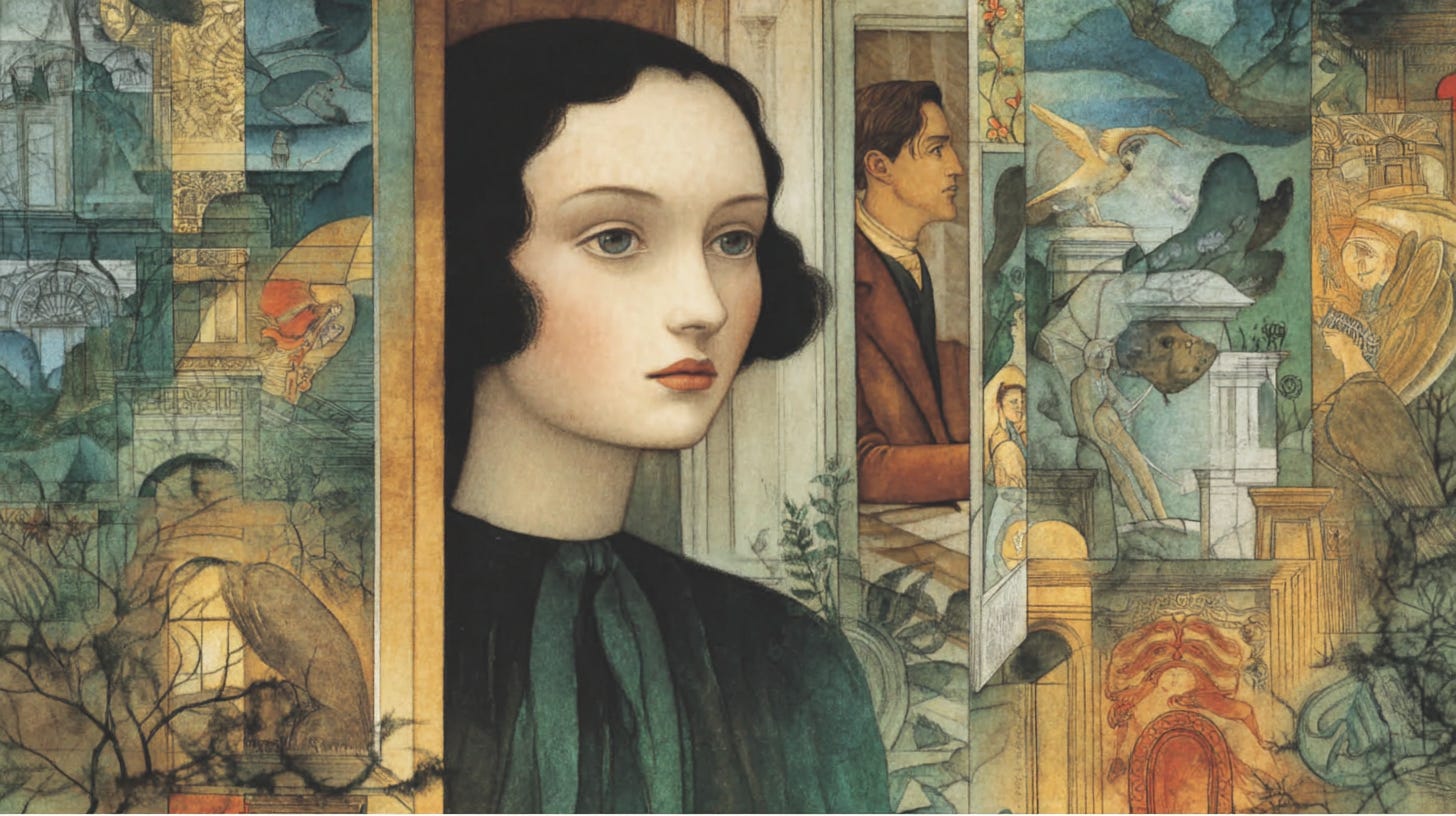
At the turn of the century, in a rented room on West Twenty-third Street, Judith Alden found herself measuring the distance from the bedstead to the door. It was seven feet, perhaps a little less. The window was farther, though not by much. Across the street, a man in a brown coat paused beneath a lamp and she judged the space between him and the curb before he moved again. She had done this since childhood. For Judith, rooms arranged themselves in lengths. Streets were observed and estimated. She had even learned to attend to silence and measure that too.
The habit had begun in Lenox, in the winter of 1885, when she was eleven years old. The town had donated its raised funds to Mister Pulitzer that morning. Her brother Thomas was dead before supper. Her uncle Sloane had killed him in the yard by the woodpile and then gone into the shed and cut his own throat with the same knife. There was no mystery in it after that. There was only the body of Thomas upstairs, washed and laid in his bed, and the body of Sloane below, put into a plain coffin in the front parlour because there was nowhere else for him. Snow came hard that evening and harder the next day. The road was bad. The ground was iron. No neighbour came farther than the gate. Her father remained in the house, moving from chair to chair with his hands folded, while her mother did what requiring doing and asked no one twice.
By the second day the parlour had a smell. The cold slowed it but did not stop it. Something sweet that Judith noticed everywhere in the house. Faint, unspoken of, but present.
On the third night Judith woke because the house had made a noise. It was not loud enough to frighten her, but it brought that uneasy feeling that sound inspires after midnight. She went barefoot to the landing and saw light from the parlour door. Her mother was kneeling beside Sloane’s coffin with a pencil in her hand. She leaned close to the floorboard and drew one straight mark, no longer than Judith’s thumb.
Judith did not ask what she was doing. The coffin stood where it had stood all day, or near enough to it that no one else might have cared. Judith cared. She saw the narrow space between wood and line, and knew at once that the mark was not for where the coffin was.
It was for where it had been.
After that, the marks increased. Judith did not see her mother make each one, but she saw them when the parlour door stood open and no one was near. They lay in a row beside the coffin, slight pencil strokes on the scrubbed board, each one a little farther back than the last. She began to count them in her head. At first the numbers came of themselves. One inch in a night, or near enough. The parlour was fourteen feet from the hall door if measured from the front legs of the coffin. Less, if measured from the end.
Her mother went in early, before Judith’s father came downstairs. Judith would hear the latch, then the soft halt of the steps within the room. When she came out she carried the same face to the kitchen. Calm and pale and already busy with the stove. Her father did not ask questions. He sat where he was set and ate what was put before him.
All day the house moved around the coffin. A bucket was carried past it. A shawl was taken from the chair beside it. No one turned their head. Judith knew, before she had words for such a question, that there were two fears in her. One was that Sloane would reach Thomas’s room. The other was that he would not.
On the fourteenth night she passed the parlour door and the sweetish smell was gone. She did not know what that meant. She did not ask.
On the fifteenth night Judith did not rise.
She had known since morning that the count was finished. The last mark lay so close to the parlour door that even her mother had stood over it a long while before turning away. No word had passed between them. Mother had made bread. Judith had washed the cups. Her father had slept in his chair with one hand open on his knee.
At night Judith lay under the quilt and kept her eyes on the dark above her. The house was still. Snow pressed against the windows. Somewhere below, the parlour held its shape around the coffin.
Near midnight, she heard the latch lift. She did not hear a footstep after it. She did not hear her mother speak. There was only that small metal sound, followed by a silence that came up the stairs and entered her room.
In the morning Judith came downstairs before her mother was up. The parlour door stood open. The room was empty. At the far end of the hall, the door to Thomas’s room was shut, and the smell that had left the parlour on the fourteenth night had found its way there instead.
She went to the kitchen and put the kettle on. When her mother came down neither of them spoke of it.
By the time the ground softened enough for burial, Sloane was gone from the house, and Judith never crossed the parlour threshold again.
Fifteen years later, in Manhattan, Judith still measured. Doorways, beds, windows, streets, hands laid on tables. She no longer asked herself why. Some habits are not habits at all, but survivals. The world had once moved while she slept, and she had learned to count the distance before it reached her.
THE END
More of Jonathan B. Edvane’s work can be found here.
The Hall welcomes your fiction stories or fragments. Submit yours here.
The restraint here is breathtaking. You captured something terrifying without gothic tropes—just pencil marks and an eleven-year-old's cold logic trying to quantify grief. The final line—‘The world had once moved while she slept, and she had learned to count the distance before it reached her’—shows masterful character synthesis. This resonated so deeply with how trauma lingers in the body and mind. The idea that hyper-vigilance isn't just a quirk, but a survival mechanism, is something so many people live with quietly. You managed to take an abstract psychological state and ground it in something physical, tangible, and eerie.
Can I just add that I adore the artwork AUdrey created for this.